Screen grab video of what seedSpark looks like now. I love frame buffers.
seedSparkPrototype from Maia Gr on Vimeo.
Monday, February 25, 2013


Tuesday, February 19, 2013
seedSpark basics

Friday, February 08, 2013
Happy mistakes

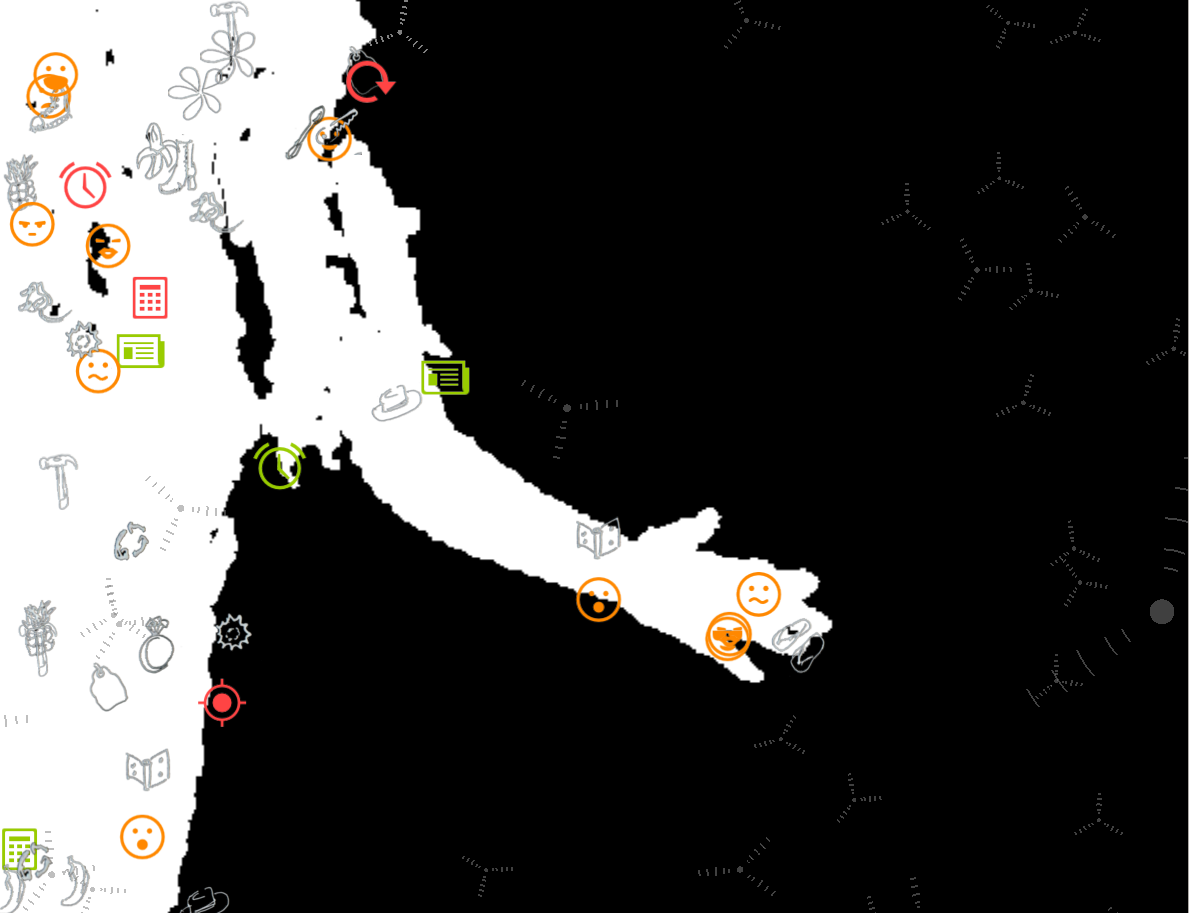
I am trying to update old projects to run on the latest version of openframeworks on a 64bit machine not a 32bit one using newer versions of the OpenNI libraries. Things are not working as expected. There is also a weird flickering that happens when I make the software not redraw the background (ofSetBackgroundAuto(false);) Luckily I found a fix. Switch the double buffering off in main.cpp by calling window.setDoubleBuffering(false);
Other weirdness though in interface instead it doesn't see me anymore :( . But it does make this Esher-like image when it thinks it should see me.
Sunday, January 13, 2013
Workbook springpad
I love my workbook but more and more I collect Web references and produce digital artifacts. I have tried different link collection mechanisms and tablet notepads but I never use any of them for a length of time. This weekend I played with springpad. Even though I don't draw in it, it is the most useful for all the other features. The board view where I can rearranged notes, links, images and to do lists in a free form way is my favourite feature. Of course access across my devices and in the browser also helps. We'll see how long it lasts. It has to coexist with the workbook though.

Thursday, November 08, 2012
openframeworks on Nexus7 and Galaxy Nexus
This is just an openframeworks polygon example. But it is running on both my Nexus 7 and my Galaxy Nexus. This means I have the dev environment all setup to build something and it's alive. There are some camera issues on the Nexus 7, but enough toys for exploration nevertheless. This installation process worked mostly augmented by this thread on the openframeworks forum. Using the development branch of openframeworks on github.


So, hmmm, decisions, decisions will it be processing or openframeworks for this project, or maybe one of each.
Saturday, October 20, 2012
Running processing example on nexus 7
Messing with processing again. Running the particles example on the Nexus 7 android tablet. Couldn't be easier, startup processing and open a sketch. Press the android button and run the sketch. It builds the apk and transfers it to the device. Of course it helps to have the Android SDK installed and working and I had to point processing to the SDK. This screenshot is of the Daniel Schiffman Particles example that was included with processing.

Sunday, September 30, 2012
Report on Free Particle


Webjay performance coordinated by Anne Roquigny at the Wits Art Museum using the wj-s system. The other artists who performed as well were Mohammed Nagdee, Murray Turpin, Joao Orecchia, Farrell Lewis, Zen Marie. More info on the Wits blog. Video clip of the master session of my set.

Exhibition installation with the students of Wits Digital Art Department at the Sci-Bono science center. Group discussion hosted by Tegan Bristow on joburg.radio. The topic was "Role of art and technology and its cross-development".
Workshop titled "XBox Kinect for Artists " co-presented with Tegan Bristow.
Wednesday, September 12, 2012
Getting ready for Free Particle
Does the pc fit into the suitcase? Getting ready for Free Particle. From the website "Free Particle is a digital art exhibition and reflection supporting practice and technical learning around Digital Practice in South Africa. It is a artist in residence exchange and collaboration between the Ososphere Festival in Strasbourg and the Division of Digital Arts at Wits University."


Sunday, August 26, 2012
pining for pointclouds - almost there again

soon, very soon. Setting up kinect environment again. ubuntu 64bit this time and openframeworks version 0071 with ofxKinect addon. Just the example but one version of the drivers and projects ok.
Tuesday, January 10, 2012
video documentation - nullPointerException
Here are the video clips to document the show. Music provided by mobygratis.com.
Friday, November 11, 2011
nullPointerException Exhibition at PJ Olivier


Sunday, November 06, 2011
tests and installation
As an initial preparation I went through each of the pieces and tried to think which parameters would be different in the gallery space. Since I wasn't sure which pc's I could use and they all vary in speed and the screen resolution wasn't completely clear either, the number of particles in each piece needed to be variable. More particles = fuller screen but slower response. I made these parameters variable so I could read them from a file. This means I can tune the installation in the space without doing a recompile.
To get final measurements of the screen sizes and for general sanity I did a pre-install test run.

As part of the installation process I made 6 identical usb disks which will auto boot into ubuntu and have all the kinect drivers installed and have the pieces on each disk. This will make the installation easier because I can borrow PCs from people and just pop the disk in and run up the work.
Prepare packing lists and order wood for the screens. Visit the gallery space again and measure and marked where everything has to go. Pack and early Saturday morning started the installation.
 Lessons learnt: You can never have enough extension cables. USB cabling is difficult if you want the pc hidden and the sensor in an optimal position; need powered hubs and active USB extension. Bring food.
To get final measurements of the screen sizes and for general sanity I did a pre-install test run.

As part of the installation process I made 6 identical usb disks which will auto boot into ubuntu and have all the kinect drivers installed and have the pieces on each disk. This will make the installation easier because I can borrow PCs from people and just pop the disk in and run up the work.
Prepare packing lists and order wood for the screens. Visit the gallery space again and measure and marked where everything has to go. Pack and early Saturday morning started the installation.

Saturday, October 08, 2011

Sunday, October 02, 2011
memory leaks begone


The first graph shows the memory foot print over night taken at 60 second intervals. The spikes happen when the software detects someone there. The second graph shows a more complicated piece that detects users and hand movements. This is a preliminary test but it is looking promising. In this case the spikes are people detected and hand movements. It releases the memory again if it forgets about a user but this only happens after a while.
Here is the bash script I used to record the memory samples: It takes 2 parameters the sleep interval and the process id.
#!/bin/bash
if [ $# -lt 2 ]
then
echo
echo "This script needs at least 2 command-line arguments: sleep interval and process id."
exit 1
fi
while true; do
#echo "infinite loops [ hit CTRL+C to stop]"
ps --no-heading -o rss $2
sleep $1
done
I created the graphs by feeding the script results into gnuplot.
Thursday, September 22, 2011


Tuesday, September 13, 2011
null pointer exception - work in progress
null pointer exception from Maia Gr on Vimeo.
ideas and intentions are converted into code
code runs on machines
people interact the code and the machines
code runs too quickly to see
code hides
code can be understood for a short while by some people and then they forget and have to reread it
the kinect can only see me sometimes
I can move too quickly for the kinect to see
I can hide behind the door
documentation of 4 software pieces coded in openframeworks and using the kinect with OpenNI and PrimeSense drivers on ubuntu 10.04
Thursday, September 08, 2011
making sense of it all -or- what was I saying again?

Thursday, September 01, 2011


Friday, August 19, 2011


Friday, August 12, 2011

Subscribe to:
Posts (Atom)